
For a family or personal protection dog trained from the ground up with weekly sessions, plan on about 10 to 12 months, followed by maintenance for the life of the dog. Where your dog lands in that range depends mostly on its age and its drive. If someone promises a finished protection dog in a few weeks, they're usually selling a dog that already had most of the training, or skipping steps that matter.
People are often surprised when I tell them it takes most of a year. But a protection dog isn't just a dog that bites. It's a dog that bites only when it should, lets go the moment you tell it to, and is calm and safe the rest of the time. Building all three takes time.
Why it takes that long
- Control comes first. A dog without rock solid obedience has no business doing bite work, and foundation obedience alone takes weeks to months.
- Grip and confidence are built slowly. Rushing bite work creates dogs that are frantic, weak in the grip or unsure under pressure.
- The out has to be bulletproof. Releasing on one command, every time, under pressure, is the hardest and most important skill in protection work.
- Dogs mature on their own schedule. Many working breeds keep maturing into their second year, and some things can't be rushed until the dog is ready.
- Real life has to be trained. Your home, your car and your walks are different from a training field, so the work has to move into those places.
The four phases
Phase 1, months 1 to 2: Foundation
Obedience the whole family can rely on. Engagement, focus and a dog that works for you under distraction.
Phase 2, months 3 to 5: Drive and grip
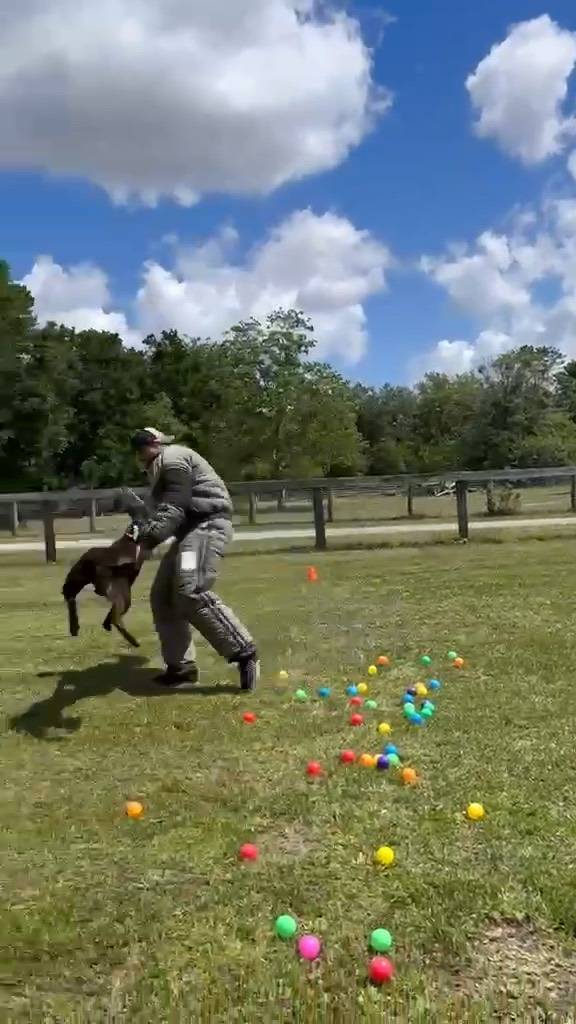
Building a full, calm grip on tugs, pillows and sleeves, and the most important word in protection work: the out.
Phase 3, months 6 to 8: Control under pressure
Bite on command, release on command, and obedience with a decoy in the picture. This is where a dog becomes trustworthy.
Phase 4, months 9 to 12: Real world
Scenarios built around how you actually live: your home, your vehicle, your walks and public places.
Ongoing: Maintenance
Protection is a skill, and skills fade without practice. Most dogs keep a quarterly tune up, and some need monthly work.
What speeds it up, and what slows it down
- Drive. A dog bred with real drive for the work progresses faster than one that has to be coaxed.
- Age. A young dog may need time to mature before some phases, while an adult with solid obedience already in place starts ahead.
- Your homework. Owners who practice obedience between sessions see faster progress.
- Consistency. Skipped weeks cost more than they seem to.
What "finished" looks like
- Friendly and relaxed in public, at home and around your kids
- Alerts and engages on your command, or when a real threat appears
- Releases on one command and comes back under control
- Guards you, stays with you and stays clear headed under pressure
- Handled confidently by every adult in your household
Buying a trained dog instead
If you'd rather skip the year of training, a trained or started dog is an option. You'll still need handler training so the dog works for you, and the dog will still need maintenance. It also costs more up front, because someone else put in the year.
Questions
Can any dog become a protection dog?
No. A protection dog needs the right mix of drive, nerve and stability. Many dogs are better suited to being well trained family dogs, and an evaluation tells you which one you have.
How much does protection dog training cost?
At T3, protection training is $200 per session, weekly, for 10 to 12 months depending on the dog's age and drive, starting with a paid evaluation. See how much dog training costs in St. Augustine for the full picture.
Is a protection dog safe around kids?
A properly bred and trained one is. The whole program is built on stability and control, and the family learns the rules alongside the dog.